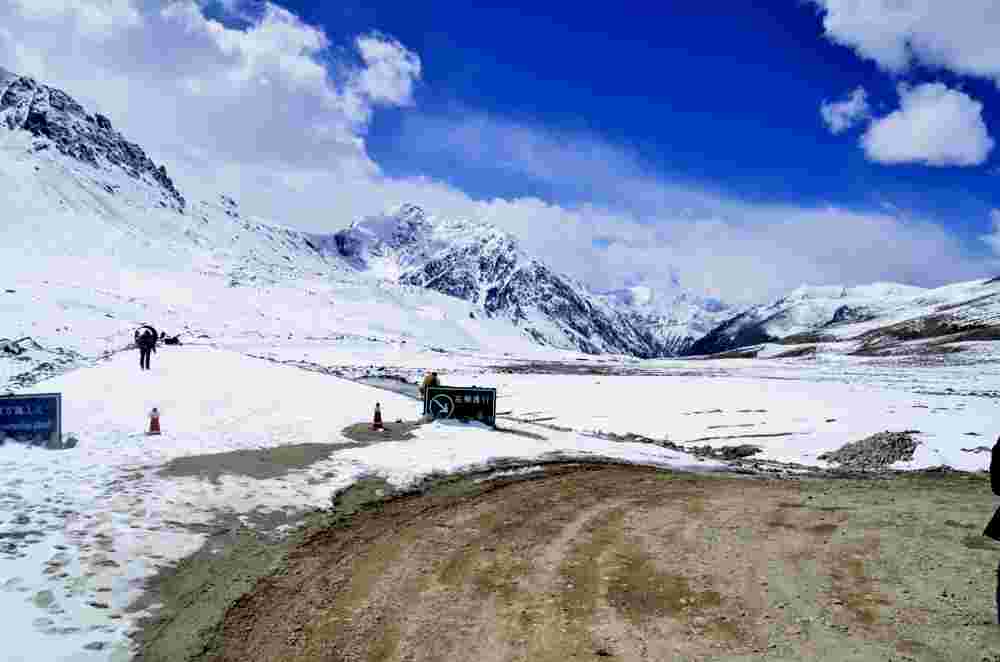
Pakistan – The Hunza

Sept 25 – Passu

After a deep sleep I was unable to sleep past 6:00 and so walked the street (only one) of Sost for a bit, before anyone in our hotel was up. Sost is a border town in the mold of other central Asian border towns. Ramshackle buildings serving as hotels, quick food places, money changers and probably expediters. Our hotel is one of the few solid buildings. On the street at this time quite a few people are out looking for rides on into Pakistan. There are no women and the men almost universally have the over shirt that hangs down like a dress. I met the Pakistani we first met at the station in Tashkurgan. He was negotiating a ride in a mini van down the road; ultimately to Peshawar.

We had an egg and toast breakfast and then headed down the road. I stopped every few hundred meters for a while as pictures leaped out at me everywhere I looked. Soaring mountains rising straight up from the road; groves of trees and fields trying to turn yellow; friendly people, all of whom waved and offered their hellos. The road initially was fresh smooth metal (tarmac), but ultimately we caught up to the road crews and for about 15 km dealt with the Chinese road building crews. Each village we passed through showed us lots of interest. I was given two apples, which grow abundantly everywhere, by young girls who let me take their picture. The fresh metal began again and we had a long fast coast ever downward as we followed the Hunza river south.

Before noon we stopped at Passu and checked into the recommended hotel, had a light lunch and walked in and around the town, as our hike in the area. The people in Hunza are Ismaili and that means the women are not as skittish about meeting unknown men. In Passu we walked around the winding rock lanes and the similarly constructed houses. Each had a patch of garden and apple trees laden with over ripe fruit. It looks like they do not have use for the abundance of apples grown here. It is particularly nice here that the women and young girls say hello and are not overly withdrawn, as will likely happen as we go south in Pakistan.
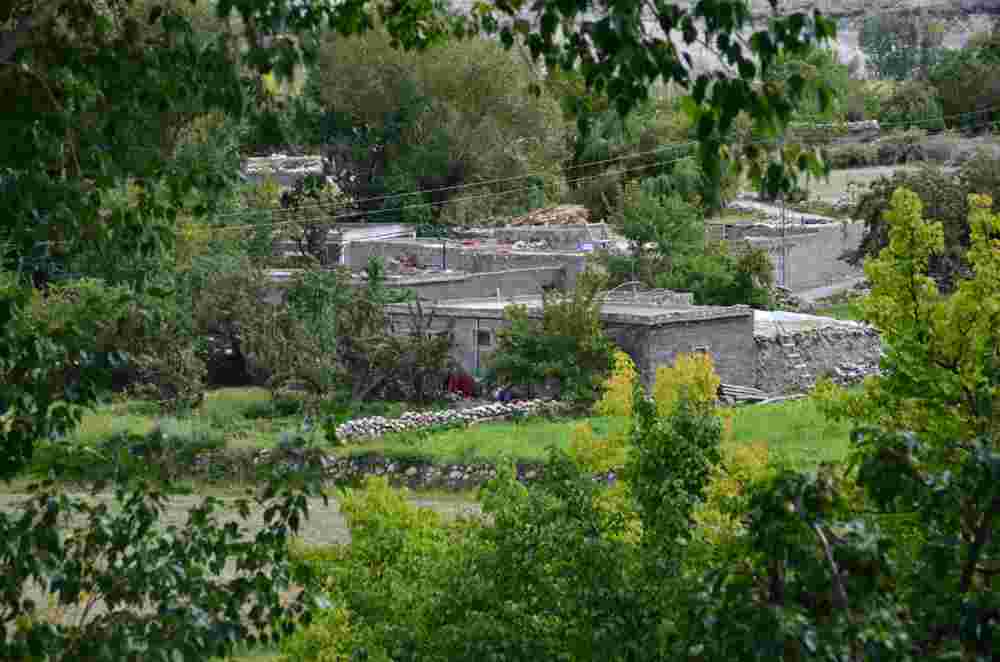
We had a nice dinner in the hotel and the owner is very pleasant with what proved to be accurate informaion about the way ahead.

We had an easy 40 km ride from Sost today, and a three hour walk.

Sept 26 – Karimabad

We had a nice english breakfast at 7:30 and headed on down the road within the hour. The new metal highway continued, but to keep us honest we had a 200 m climb just out of Passu, which meant that we had a long look down to the river far below us, and then a long fast run down to the river bottom just as the metal ended and we had a 2 km very rough track to the mayhem that is the boat loading area for the newly created lake. .

|There is no dock, boats of various sizes are nosed into the bank and hundreds of porters are carrying loads from the trucks down to the boats. There is no official place for us to buy a passage. We are told we can get on a boat almost loaded. I start to make my way down the bank with my loaded bike, but when I came to big step down in some rocks two porters, one front and one back, grabbed my bike and carried it the rest of the way down. I gave each the equivalent of a dollar. Rich had one guy carry his bike and bags in two separate trips down. The loading continued for another half hour and we were underway.
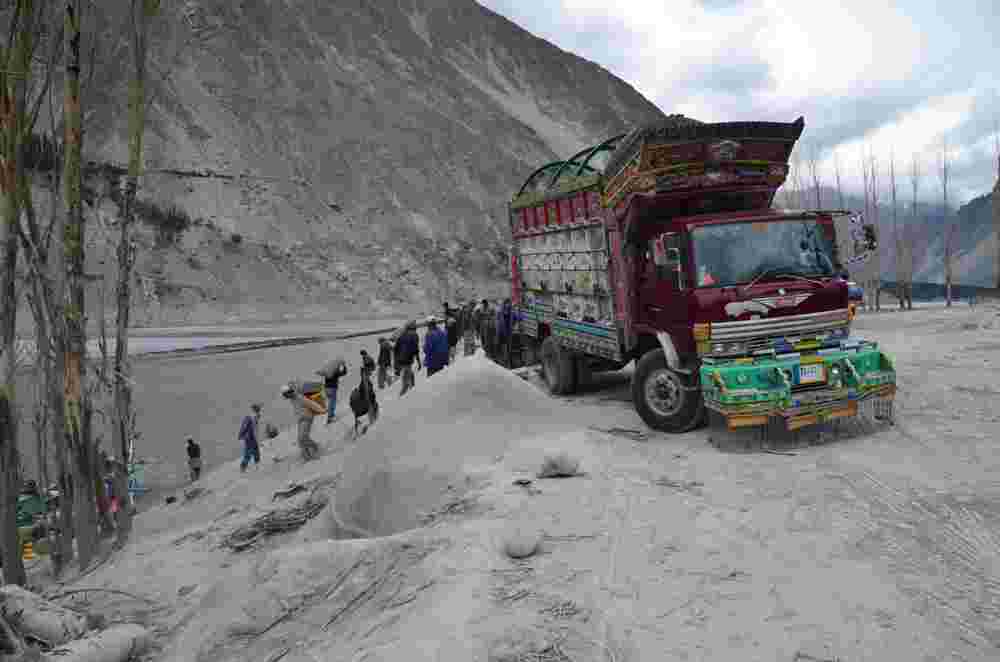
At this point we are still in the fast flowing Hunza, and a few minutes into the trip we got stuck on a gravel bar. It took our captain half an hour of powering first one of the rooster tail motors and then the other back and forth before we finally broke loose and continued on into the lake proper.

It took us about two hours to cross the 27 km lake that was formed in 2010 when the avalanche that dammed the Hunza occurred. The lake has wiped out the road effectively locking the people above the lake out of normal commerce with the rest of Pakistan. What was created was this lake transport business. The transport boats have been brought in from the Punjab and the boat captain is probably Punjabi as well.

The real excitement happened when we came to the end of the lake. A number of boats were already there, possibly in the best places. We pulled up close to the huge boulders that were deposited by the avalanche, getting to within a meter of the rocks when close to a dozen guys jumped on board and started fighting over our bikes and bags. We had to step across the meter gap to a big boulder and then clamber up through the boulders following our gear. At the top we had a great hullabaloo as every one wanted money. Rich had no little money and so I handed out about 8 dollars to one guy and then hoped that he would distribute it among those that actually helped. Probably not. Our boat ride cost us 500 rupees (~$5+) each. I imagine the porters would be lucky to make $2-4 a day carrying cargo between the boats and trucks.

Now we had 15 km of extremely bad road to get to Karimabad. It started with a rough track up and over the avalanche and then onto the old un-improved KKH. Lots of dust and some considerable climbing which got us way above the river, followed by a bone and bike jarring ride down. Over half an hour pulling on the brakes tested our wrists as well.

It is all over now, after a tough climb back up from the river to a lovely hotel overlooking the green amphitheatre that is Karimabad, the main town in Hunza and which is also referred to as Baltit. We washed out bikes, got more money, had coffee and cake in a coffee house and had a blissful shower. And now we wait to go to dinner. Hopefully the power will come on by then and we can connect to the wifi the inn keeper claims they have. We will spend 2-3 nights here to clean up, do a hike and recuperate.

Today’s ride was 35 of the toughest kms I have ever done.

Sept 27 – Karimabad
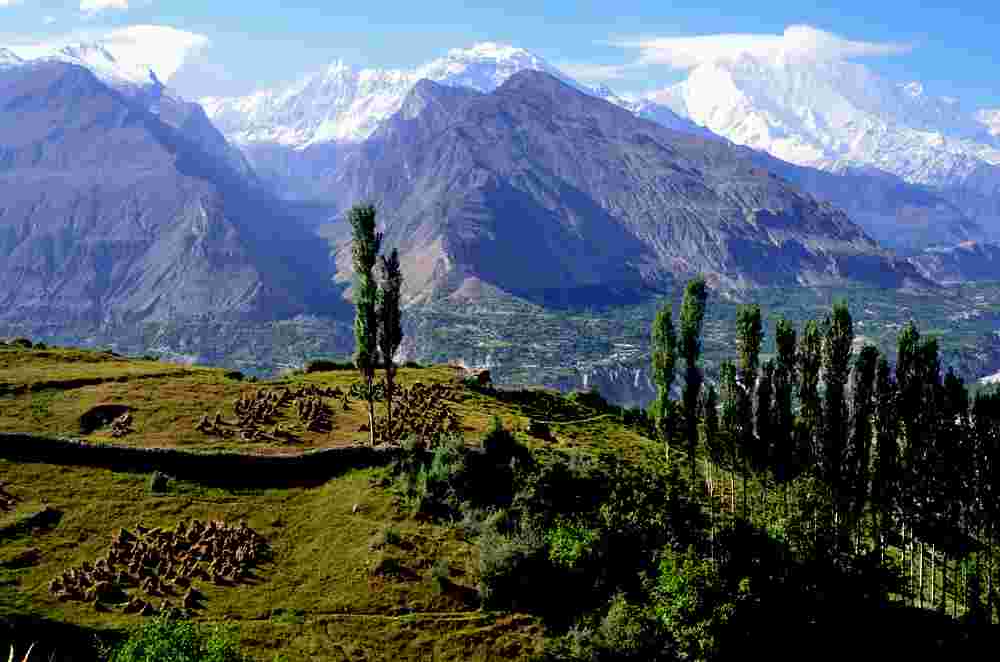
I awoke this morning as the sun was rising on the flank of Rakaposhi, 7788 m, that dominates the southern views from |Karimabad. Rakaposhi and its sister mountain Diran, 7270 m, both snow covered year round are part of what makes the setting for Karimabad so spectacular, and in part why Rich and I are planning on three nights here. Today we have contracted with a local guide to shepard us up to the Ultar glacier, which spills down from Ultar, 7388 m, on the north side of town.

We started out about 8:00, winding up through the labyrinth of lanes and passage ways through the town. Our guide, Karim, talked to us about the schools in town, as the children were lined up for their procession into school to begin the day. One of the schools was built by a Japanese woman whose husband died in an avalanche while climbing Ultar. Part of our walk was along the canals that bring in glacier water to feed the fruit and nut fields that seem to occupy more of the town than buildings do. Our way up connected us to three levels of these canals, the uppermost of which took us around to a gully that would take us up to the Ultar glacier, our destination.
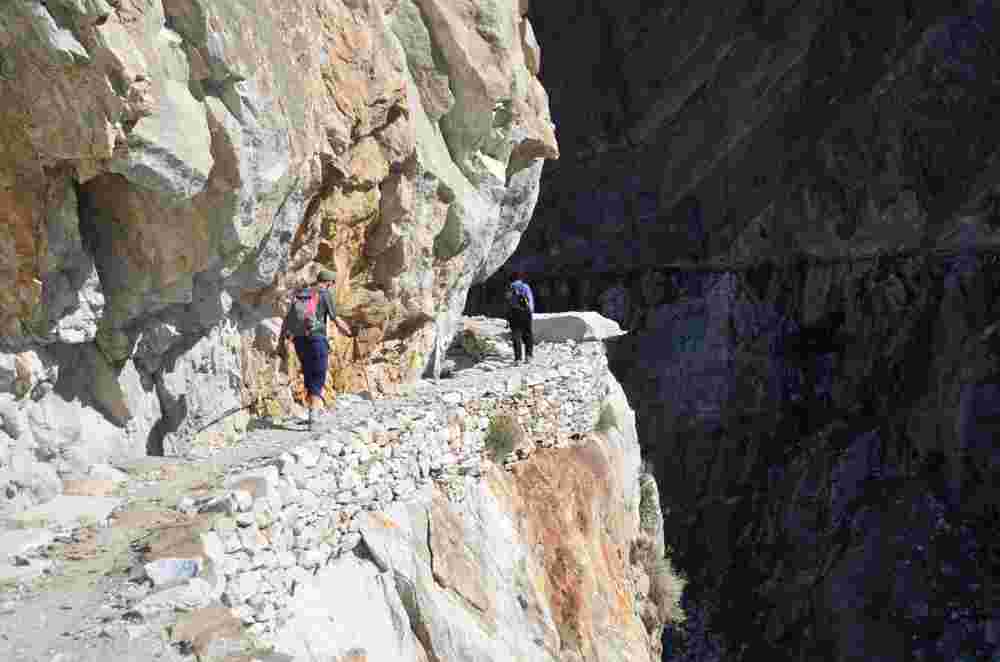
The path along this highest canal was very narrow and breaking away in part. I was looking out at Diran and Rakaposhi as they were continually rising to more prominence as we climbed when I heard a yelp from Rich. I turned to see him head down over the side of the path and Karim rushing to grab him. He had put his walking stick down to balance and there had been no purchase for the stick and over he went. I am not sure if he would have gone if Karim had not been there, but it would have been close. He came out of it with bad abrasions on a hand, his arm and a banged up knee. We made our way to a better place to stand and he washed up a bit before we carried on. After a bit, the trail now much wider again, shock settled in a bit and he had to sit down to collect himself. We carried on, but it was certainly a close call.

Once off of the canal paths, a steep rough trail took us up the gulley to a lovely meadow overlooking the glacier and Ultar rising above. We had our hotel prepared lunch and tea cooked by Karim’s brother who is working on a project to bring spring water down to Karimabad. We continually had to shoo away the goats who were bound and determined to share our lunch. We enjoyed a pleasant hour watching the clouds waft around on the spires above us.
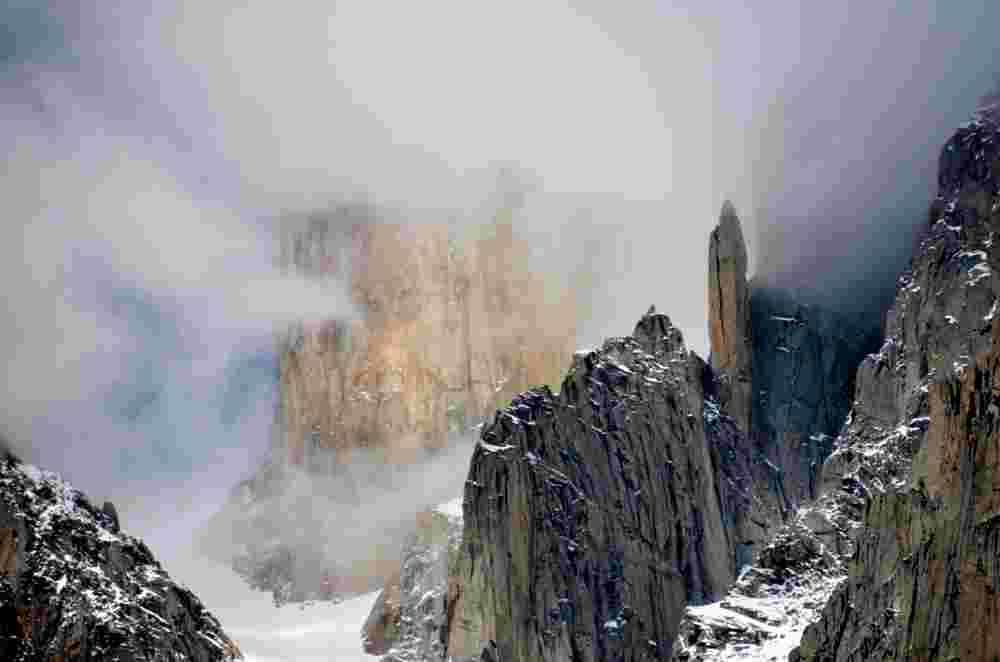
Our way down seemed slow as Rich’s knee was now quite stiff, but in fact we didn’t take any longer than most groups. Instead of taking the canal paths we continued down the gully and up over a ridge next to the Baltit Fort, that overlooks the town and for 800 years, until about 50 years ago, been esidence of the Mir of this area.

Sept 28 – Karimabad

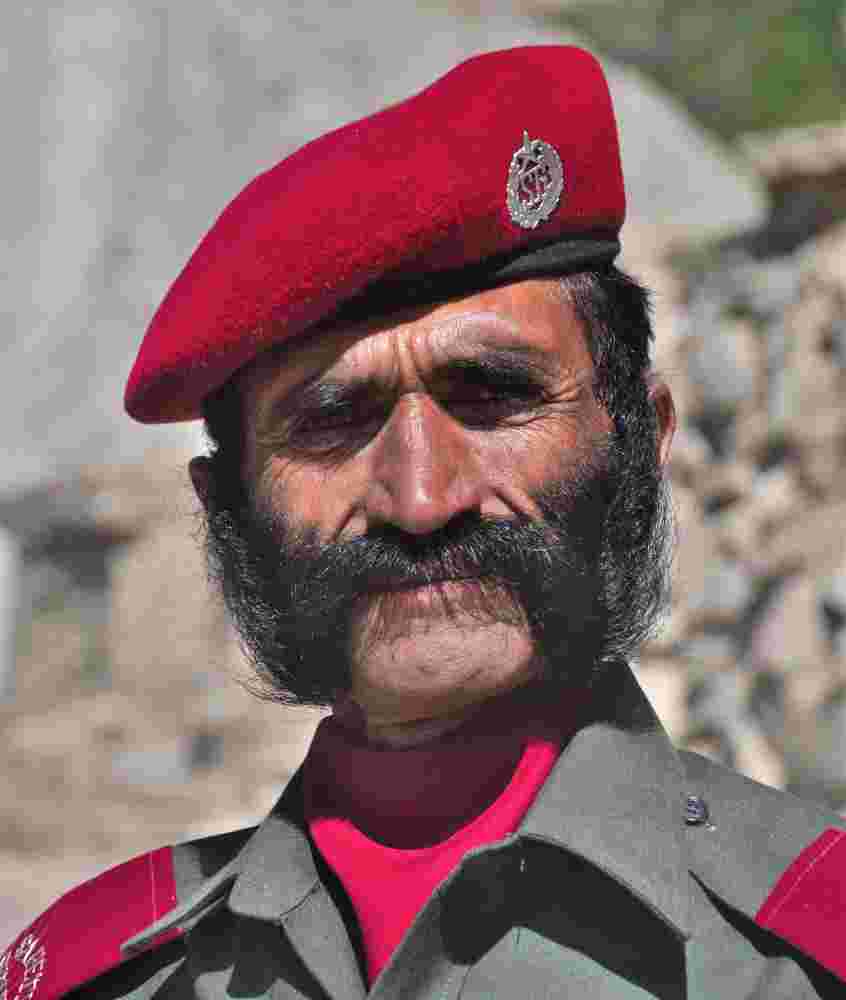
This is primarily a rest and clean up day. We are having our clothes washed and walking about town to see things a bit. I started by taking a tour of the Baltit Fort to see how the Mir liked through the centuries. The Mir was both secular and religious leader (Imam) for the Hunza people. One interesting thing I was told was that for hundreds of years the Mir sent some gold each year to China in return for tea and other commodities. A pleasant old war veteran allowed me to take his photograph outside of the fort; he was obviously very proud of his past position.
The fort is heavily fortified as they were continually at odds with the Nagyr, who live across on the south side of the Hunza river. To this day things are not copacetic between these close neighbours. One difference is that the Nagyr practice Shiite to the Hunza’s Ismaili doctrine.

In the afternoon I went to Hasegawa Memorial Public School and College, the one funded by the Japanese in honour of the fallen climber. I had tea and talked with the Principal for a good hour, on all manner of things in addition to education, including such things as religion and the treatment of women. This reinforced the developing opinion I am gaining about the how open people here are and how skewed our perception of Pakistanis can be.

Living so far away and being primarily exposed to people through the international press they attract it is so easy to be misinformed. In just a few short kms into Pakistan I can already see incredible variance with the public persona. The Pakistanis I have met, primarily Ismaili Hunza, do not fit any of the preconceptions one might have. The women are openly friendly, the men gracious and generous. No doubt in a country with this many people and hundreds of different groups there are no stereotypes that will work.

Tomorrow we will mount our bikes and head on down river to Gilgit, and a different group of people.

 

Posted in KKH&India | Tagged , | 1 Comment

KKH – Kashgar to Pakistan

Sept 19, 2012 – Kashgar The best thing, for me, about Kashgar are the street markets in Old Kashgar, the Uyghur part of town. The winding streets are alive with vendors, often in clusters by product. The women dress in a wide variety of clothing, most frequently with bright multilayer dresses and head wear and high heels often with sparkles on them. Most women are not face covered, but many have a half cover or just the eyes showing and a small number have the full covering usually of a dark brown that must be hard to see through. Children on the way to school or just playing add a playful flavour. The people do not seem to mind our intrusion and will let us take pictures. I took Rich on a walk of some of my favourite areas and was shocked by the amount of re-building that seems to be going on in the old mud and straw warrens since I was here two years ago. But business goes on as it has for thousands of years. The men congregate in great numbers in the streets closest to the mosque. They stand in groups talking and sometimes bargaining often on carpets. No doubt most will wander into the mosque frequently to pray. We arrived here last night around dinner time. From the balcony of our third floor hostel we look out on Id Khan mosque, the largest in Kashgar. Our flights all went fine, but five flights, six airports and 36 hours on the move really do take a toll. Our bikes and luggage seemed to have handled the trip better that us. But a few days here and we will be fine. In addition to the street visiting, we cycled around looking for a bike mirror for Rich and talked to people at the other hostel and to John’ at his restaurant in the Seman hotel looking for information on the road ahead. We did pretty well at both places.Our best meal was the night we arrived at the Eden hotel where I stayed two years ago. The restaurant is upscale Turkish and has a great variety at good prices. Our meal tonight, in the commercial part of town was no where near as good. Our last night we will likely go to the Eden. Sept 20 – Kashgar After another leisurely morning we cycled to the big market and spent an hour of so wandering the labyrinth of shops. It is good people watching, although we left before it got busy. I had to have my front chain ring replaced, as it got bent in transit. My Dahon has really been through the mill on each of the three major trips it has carried me. We bought some food for the way out tomorrow and will eat a bed-room breakfast and get away shortly after sun-up. Tomorrow the KKH. Sept 21 – Police Checkpoint at Ghez We got ready to leave, eating as we prepared. We even had coffee, thanks to the ubiquitous Chinese thermos of hot water, always available everywhere you go. We were on the way at 8:30 Beijing time, which means it was still dawn. We had to ride to the end of the block, catch a main drag to a traffic circle then choose the right road out of five which would take us out of town. You have to accelerate to get into the traffic and cut across the lanes to make the correct turn. Rich was behind me going into the circle and I stopped after making our turn. He didn’t turn up.After a couple of minutes I rode back against the flow and looked into the only other road he may have taken. He wasn’t there and so I headed up that road as fast as I could go. To make a long story short, we didn’t connect. I rode back and forth up all the roads, circled the round-about a number of times and after close to an hour and 20 km I headed back to the hostel. He wasn’t there and hadn’t been back. I headed off hoping that I would catch up to him in a few hours. He had to be ahead of me.

The road out of town went through busy suburbs and industrial areas for about 20 km and then I started to see the mountains rising above the fields and the road started to climb a bit. The road is excellent and so I was making good time. Some hours into the ride a vehicle stopped twice and took pictures of me. After the first time I thought that I should have asked them to tell Rich that I was behind, if they caught up to him. And then they stopped again and when I made my request they said he was only a few kms behind me. I waited on ahead at a good spot and he turned up after about 45 minutes. He had similar stories of riding around the traffic circle, and we figured out how we missed each other there, but could not figure out how I got ahead of him. He was well on his way at 9:30, when I was at the hostel. We had a good lunch after meeting, and it was good that we did. The ride was very nice, particularly the red rocks in The Ghez river canyon. But it was long. We were on the road 11 hrs, I rode 140 km, Rich 120 and we gained 1000 m en route.

At the police checkpoint we were lucky to get a spot to sleep in a rough yurt, where we were joined by smoking truckers during the night.

Sept 22 -Lake Karakul

we were slow getting away, as we needed light to organize ourselves and to find a few things in the kiosk to eat. We went through the police check a second time and began the steep climb up the tumbling canyon. For the next four hours, averaging 7 kph we ground our way up, dodging the multitude of trucks and road crews, and fighting the wind whistling down the canyon. I stopped frequently, for only a minute or two, to drink, catch my breath and to let my thighs recover. But Rich struggled even more and had to get a ride for 20 km as he felt that he would not be able to get up the canyon with enough energy left to get to Karakul. At the top of the canyon, the trucks were gone for a while and there was a smooth 5 km ride along a lovely lake. I met up with Rich where his ride dropped him and we climbed up a river with wonderful views of Mustagh Alta and Kongur rising above the fields and grazing animals. One more steep climb revealed Karakul and the scattered yurts along the shore. I stopped at the entry arch to wait for Rich and a woman came walking across the field and gave me sleeping and eating signs and said “wu shi” and pointed at her yurt over on the point. 50 yuan to sleep and eat at her yurt. Then I noticed the familiar little moon faced boy with her. Sure enough, it was the same woman that I stayed with two years ago. I tried to indicate two people “er ren” I tried and pointed down the road, where Rich was now in sight. But she started to walk away, I guess she could handle one guest. We went into building which seemed to be the centre of things, which has a full featured dining room and yurts out back. After an enormous bowl of soup we arranged ourselves in our lovely yurt which could hold 10 people, and then went back at about 8:00 for a full meal. Today we rode 65 km in 8 hours and gained 1400 m. Sept 23 – Tashkurgan We had a great breakfast watching the sun rise on Mustagh Ata and got away at about 8:00 (10 Beijing time). It was very cold and we had about 80% of our cold weather gear on. The ride for much of the day would be in the company of Mustagh Ata off of our left shoulders. We continued our gradual height gain and then a series of big sweeping switchbacks took us a bit over 4000m. I felt so much stronger today, possibly because the big climb happened early. I had thought the climb would happen later and so now I was confused. I told Rich that I thought there would be ride across a plateau. In fact we started plunging down without the cold gear that the climb had shed for us. We stopped after a drop of a few hundred meters and put a bit more on, while expecting the drop to stop or the lower altitude to warm us up. It didn’t happen. When we had lunch at about 3200 m we were still cold. High up the terrain was barren rock, turning to hay and the odd grove of trees, and then finally to full on agricultural activity as harvest seems to be happening. Lots of animals and people out, and always Mustagh Ata forming a back-drop. Finally we were funnelled into a winding canyon which blotted our mountain companion and 10 km after the canyon we were in Tashkurgan. Another gorgeous day, scenery wise, but much easier than the first two. We rode 100 km, gaining 505 m, and dropping 995 m, in seven hours. We are in a room with real beds, a hot shower down the hall and beer down the street. Tashkurgan is the Chinese border town and 300 km south over Khunjerab Pass, the actual border, is Sost the Pakistan border town. We are not allowed to cycle this and so in the morning we hope to catch a bus to Sost. The Chinese portion of the KKH was exception for cycling. Great road and scenery, physically demanding, and we managed to get places to sleep and eat. We know the roads in Pakistan will be more problematic, but hopefully the experiences will be just as rewarding. Sept 24 – Sost Lots of mis-information. We thought the bus was leaving from the bus station by the hotel and that it would leave at 9:30 beijing time. When we got out at 9:00 we were told the bus was a km down the road at the Immigrations building. Off we went. I could ride but Rich had all his panniers in a big duffel and so he started walking. I rode to the end of town and found nothing, and so came back to a building that said China Customs as Rich walked up. It was still closed. We stood there for a bit, now it was getting close to 9:30, and a uniformed guy pointed down the road and said one km. Rich bungied his sack on his bike and we rode on. About 5 km later we turned back, now thinking we would be here another day. On the way back we saw another likely looking building and waited there for a while and then people started arriving. We had found the place and it was now obvious that departure was 9:30 local time, two hours later than we were told. As the time came closer the Chinese officials arrived and we were processed efficiently, and then began the wait for the bus to arrive. At 9:30 local time a Pakistani bus arrived and stuff was loaded on the roof and we found seats among the carpets and bags that had already found their way on board. We headed out at 10:00 local time, 3 hours after we had started looking for the bus and border station. Our bus is mostly Pakistani, most of whom seem to have boxes of things they have picked up in China, and a few Chinese, none of whom seem to be able to speak English. The Pakistani are better and speak good English. The 120 km in China got progressively more spectacular as we gained altitude again into the high mountains, culminating at the 4730 m Khunjerab Pass and the last Chinese border check. The road in Pakistan began immediately with a rough bypass of a road seriously under repair. We got onto the main road and then hit some tarmac which ended immediately at a stoppage. It was then 1:00, we sat there for seven hours, without ever knowing why we were stopped or when we would move on. We read, ate, walked up and down, got cold, ingested litres of second hand smoke when we had to sit in the bus to get warm. The road is being rebuilt by the Chinese and I guess they are not too worried about holding up the flow of transportation in Pakistan. We pulled into Sost and went through customs and got into a pretty nice hotel and was greeted cheerfully by an older fellow who continually proclaimed “no problem” to every request, from hot water to food. But after sitting in a cold smoky bus for seven hours we were happy to be through our first border crossing and into a nice place. Our adventure now moves into Pakistan. ,

Posted in KKH&India | Tagged , | 4 Comments

KKH and India 2012 – The Plan

Sept 12, 2012

The last few days of preparation for our Karakorum Highway (KKH) & India trip .

On Sunday, Sept 16, Rich King and I will load our bikes and bags onto the first of a series of flights that will take us to Phoenix, LA, Beijing, Urumqi and finally dropping us in Kashgar, China on Sept 18. If we and our stuff arrive in good order a few days later we will begin cycling south on the Karakorum Highway crossing into Pakistan at the Khunjerab Pass at 4695 m.   The KKH was built over a 20 year period, finishing in 1979, by the Chinese to open yet another avenue for getting their goods into the Indian sub-continent.  It is one of the great adventure cycle routes in the world. Cutting across the Karakorum Mountains between the Himalayas and the Hindu Kush, we will touch on the three highest mountain ranges in the world. Formally the KKH is 1300 km long, but we will continue on, for possibly another 4000 km or so.

A few months ago I said to Rich “My eye doctor has finally given me the go-ahead to book my next three month cycle trip, leaving mid-September. You might be interested.”

“Oh! Where to?”

“I am going to attempt to cycle the Karakorum Highway from Kashgar to Islamabad and then continue on into India, down the west side certainly into the south and possibly even into Sri Lanka.”

Rich was silent for a while and then said “You do know that the KKH formally ends at Abbottabad?”

This was a good sign because he knows that that kind of formal definition is not important to me, nor to him either for that matter. He then reminded me that last year, getting to and from his Baltoro Glacier trekking trip, he spent quite a bit of time on the KKH and had found it in a dreadful state of repair. I countered that if it got too bad we would just get on a bus for a while. After all, being septuagenarians we can’t afford to be purists. He also worried about the Chinese side but I reminded him that two years ago, at the tail end of my Chinese silk road cycle I had taken a quick bus trip from Kashgar to Tashkurgan and felt the Chinese part of the KKH would be great to ride, in-spite of the altitude we would have to gain.

Our conversation continued…

Rich said, “I can’t get away for three months”

I replied “ Well you could meet me in Islamabad or Delhi and cycle India with me, or you could cycle the KKH and return from Islamabad. “ We had done this sort of connect on a number of trips.

He thought a bit longer and then said “ I really want to cycle the KKH .“ A bit more thinking and then …”but I really want to get to South India, particularly Goa and Kerala.”

Rich was hooked.

One of us suggested…”what about if we leave out Sri Lanka?” As much as we would both hope to get to Sri Lanka this seemed like a good compromise and we shortened the trip to end Dec 1. Rich went home to talk with Mavis.

Over the next months there was the usual amount of research and preparation. We will fly home from Delhi so that we can drop some of our cold weather stuff off before cycling into the south, returning on some form of transport from the south back to Delhi for our trip home. Visas for all three countries are required and took some time. We had paper and electronic resources to acquire, equipment to decide upon and top up. We had to decide what kind of hiking we will do while passing through Pakistan’s hiking meccas and which of the countless attractions in India might draw us onto the roads leading to them. Our plans are tenuous, as travelling by bike liberates you from the fetters of transport schedules, but without a tentative plan the slow pace of cycling might cause us to miss some of our highest priorities.

So we have laid out a route of about 5500 km, which will be lengthened by variations to the plan and side trips, the cycling distance will be shortened occasionally using local transport.

You can click on this web reference if you wish to look at and zoom in/out on our prospective route.

https://maps.google.ca/maps/ms?msid=203085824206506510241.0004c8f8f1c1234305426&msa=0&ll=25.878994,80.15625&spn=8.158714,14.128418

I will attempt to add notes periodically as we progress, possibly from Kashgar…. ’til then.

Posted in KKH&India | Tagged , , , , | 2 Comments

Kayaking in Gwaii Haanas National Park

Aug 11-20, 2012

We took Zodiaks to Rose Harbour at the south end of Gwaii Haanas National Park, where Steve Konik and Christine Hawes introduced me to Kayaking (the other 7 in our crew had all done some or a lot of kayaking.

We loaded all of our food in the 8 kayaks – 6 single, 2 double and we were each given a compartment in one of the kayaks for our personal gear.  They shoe-horned me into one of the singles, showed me how to get my feet on the rudder pedals,  snapped the sea-skirt around me (an operation I was never able to do on my own), and pushed me out into the bay at Rose Harbour.

I was shocked at how tippy I felt as I paddled about waiting for all the kayaks to be launched.   Surely they remember that I can’t swim, and have never been in one of these things.  I did tell them that didn’t I?  Soon all the kayaks were out and I struggled with the rudder and the paddles to keep a straight line.  It was hard to keep up as I zig-zagged behind the others who all had kayaks that seemed to go straight.  Christine, my saviour, paddled along beside me cheering me on.

We got out of the harbour into some fairly rough water.  We were headed to our first camp.  I was flailing my paddle furiously to keep up.  Somehow I didn’t tip and didn’t fall hopelessly behind.  After what seemed like hours we headed in to face my next challenge … getting out.  Steve waded out to pull my kayak in and hold my hand as I extricated myself from what seemed to me at the time will surely be my watery coffin.  How stark the contrast between my ability here and the biking Rich and I had come from.

We set up camp, which turned out to be our home for three nights.  Rich and I have done this countless times and so I was back in a comfort zone again.  Christine cooked a wonderful dinner, the precursor of many incredible meals that she and Steve put on.

The next day, a real highlight for me, we visited SGang Gwaay.  Formerly called Anthony Island, it is the site of a village that has been declared a UNESCO heritage site.  The watchman for the site, James, showed us around and shared a great deal of history about the Haida and the site.  Many totems and other artifacts have been removed to museums around the world, the remaining vestiges of the village are being let return to the cedar jungle from which they were originally crafted.  We are so priveleged to observe this process at one point in its inexorable progress.   We kayaked out to look at some sea lions and then returned setting up camp at the same place.

Our group was beginning to gel, as we shared our snacks, our booze and our stories.  Betty and Dave from Calgary, Monika from Vancouver, Jen and Coral from Toronto and Andy from Rhode Island had all kayaked before, Coral not as much as the others. I was the only real novice

The next day we were camp bound as high winds came, but on day 4 we were off again.  We had seven great weather days as we paddled north, in and out of the islands and bays, to near Hotspring Island where we were picked up by a big Zodiak at about 7:30 pm on Aug 20.

I was moved to a wider single kayak, as my minders struggled to bring me up to snuff, and while I still struggled to keep up I was getting a bit more comfortable.  I found that balancing the thing was a bit like balancing on a bike.  You can’t fight it.  I did lose my pedals a couple of times and once, with Rich’s help I was able to lift the skirt to get my knees up enough to find the pedal.  One time I just used my paddle to steer.  In a heavy wind I found this very hard and almost needed to call for help.  By now everyone was helping me get in or out of the kayak, which remained my bug-bear.  Rich and I spent four days together in a double and found it to be faster, easier to steer and quite enjoyable.  We switched positions back and forth during each day.  In the back you steer, in the front you day-dream and gawk around.

The views and experiences each day were incredible.  Steve caught 5 Sea Bass in 5 minutes one day, which Christine battered and fried up, wonderfully.  We saw no end of humpback whales, Bald Eagles, Pigeon Guillemot, Sitka black-tailed deer.  We had periodic sitings of numerous other species.  We had a spooky fog bound crossing of Juan Perez Sound on completly smooth waters.  We spent three or four hours on Hotspring Island, dipping into three pools with varying degrees of hot.

Each day Steve, listening intently to his weather phone, created his own forcast prescribed the day’s starting times and route.  Not alone, this skill is one that would be hard for an independent to duplicate

The food, each meal was incredible.  Most notable for me, was that much of food was cooked over an open fire. It had been years since we have been able to do this in the mountains.  Christine also cooked cakes, biscuits and muffins using a little propane cooker that worked exceptionally good.

All told this is one incredible experience for me.  Thank you Ocean Sound Kayaking, Steve and Christine.

Posted in Haida Gwai Kayak | Tagged , , | Leave a comment

Cycling on Haida Gwaii

Aug 7-10, 2012

We departed from the Ferry at 6:30 am, cycled into Charlotte City and left a bag of kayak stuff at the motel we had booked and were headed up island by 7:30 am.

Graham Island is where most of the people live, and the road north to Masset is paved.  Before long we spotted some Bald Eagles and had our first siting of the very tame non-indigenous Sitka black-tailed deer.  The road was pretty flat and there was a bit of a tail wind and so when we stopped at Tlell to get a snack the little store was still not open.

Crossing inland from Tlell we hit a few hills but none more than a few hundred meters.  At Port Clements we had a nice lunch in a cute little restaurant.  Not long after that we got to Masset and set our tents up in a campground where we were also able to get dinner and check up on the Olympics.   We had ridden 120 kms.

In the morning, in the rain, we found a nice breakfast spot, rode into Old Massett to see the totems.  We wanted to see a carver there, but he would not be in business until well into the day.  We headed back towards Port Clements again, riding through a couple of rain showers along the way, and so we had some drying out to do while we had clam chowder in the same little restaurant.

Because of the rain, we booked into Serenity Now B&B at Tlell.  We got there mid-afternoon and after showering Christine allowed us into the living room to join Peter so we could watch the Olympics.

Peter took us out in his truck to look around and we saw the little Salmon river that runs through Tlell.  I was particularly pleased to see the former home of the author, James Huston, which has been preserved, complete with some well carved Haida totems.

Peter invited us to join them for a dinner of Salmon and crab.  Rich and I chose well  on this day.

The next day we rode on into Skidegate where we surprisingly found a yuppy type restaurant before our extensive visit to the Haida Gwaii Museum.  The museum has some of the best old totems, some excellent new carvings, some canoes and gives a number of talks on Haida history and customs.  Well worth visiting.

We checked into our hotel and began preparing for our kayak trip.  In the morning we watched the Olympics for a while and then took the short ferry to Moresby Island and rode the final 10 km into Sandspit and our motel.

Seeing Haida Gwaii by bike is highly recommended.  We cycled about 280 km on Haida Gwaii, including our return after the kayak trip.

Posted in Haida Gwaii Cycle | Tagged , | Leave a comment

Haida Gwaii – 2012

Aug 6-22, 2012

The drive to Prince Rupert from Calgary was excellent.  Nice weather, little traffic, wonderful scenery.  We motelled one night along the way and arrived in PR about 2:00 pm.  We had to buy ferry tickets, assemble our bikes and our gear for 4 days of biking and 10 days of kayaking.  We had halibut at Dolly’s before riding our bikes onto the ferry and our overnight trip.

We cycled North from Charlotte City, on Graham Island through  Skidegate, Tlell, Port Clements, Masset an Old Masset.  We returned the same way and then took the small ferry to Moresby Island and Sandspit where we met up with our kayak crew. (Separate Post)

We kayaked for ten days, from the south end of Gwaii Haanas National Park to near the north end.  We visited SGang Gwaay, the Haida site that is the least advanced in its gradual return to nature.  We had one stormed in day and seven days of glorious weather and wonderful kayaking. (Separate Post)

Posted in Visit to Haida Gwaii | Tagged , , | Leave a comment

Getting started

Hello all,

I am attempting to create a blog site on which I can document some of my activities, primarily related to my travels.

More to follow, hopefully.

Ken

Posted in Uncategorized | Tagged | 2 Comments